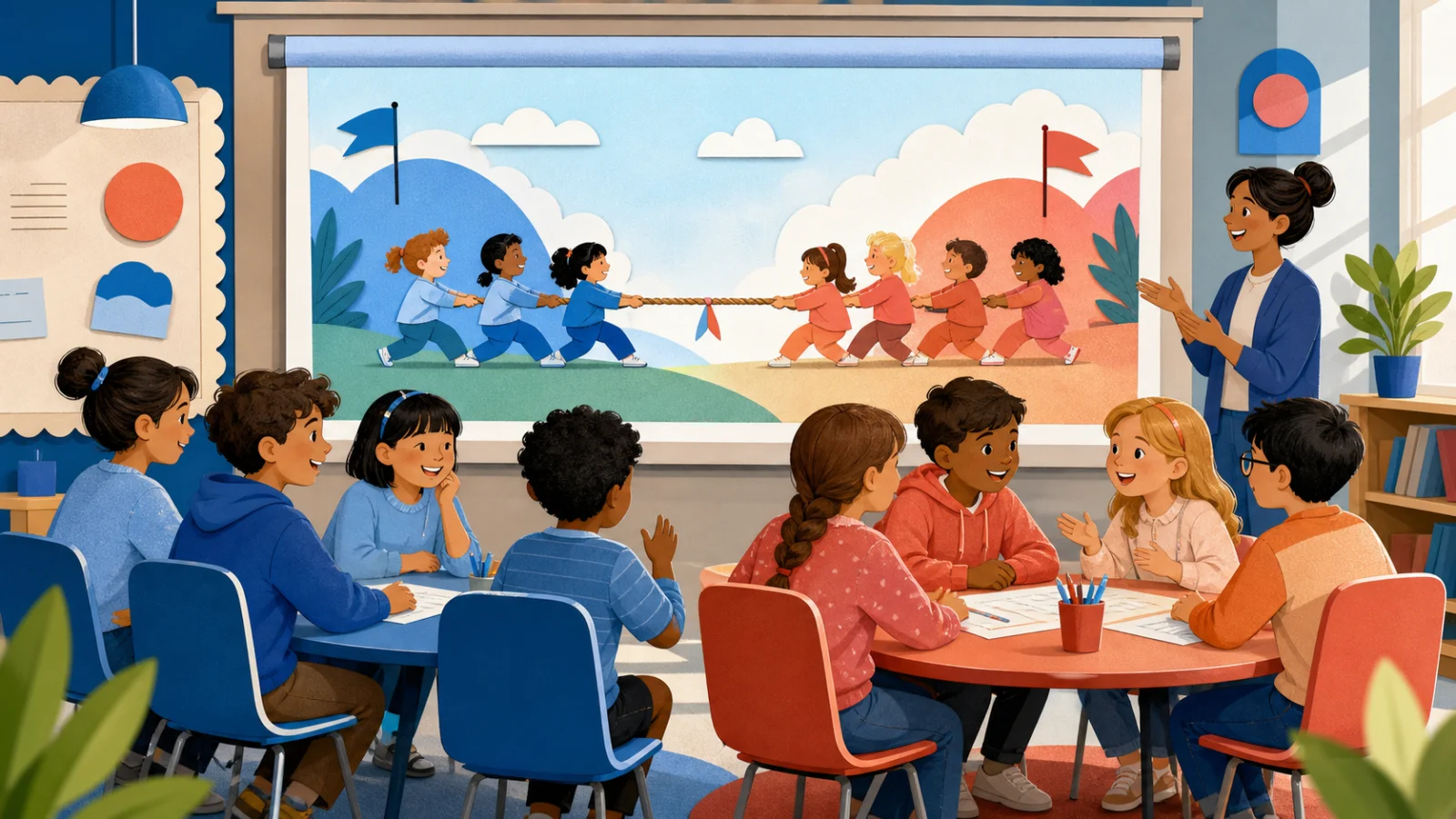
A good team quiz does more than divide the class and add points. It changes who gets to rehearse an answer, how long they have to think, and whether a wrong response becomes useful feedback. The safest design is to make discussion compulsory before speed matters, then rotate the person who speaks for each team. That preserves the excitement of a contest without turning the lesson into a performance by four quick students.
Choose a team quiz format for this lesson
Change the three constraints. The recommendation prioritises participation and feedback before spectacle.
Instant lesson recipe
Team quiz format planner
Recommended format
Think–team–reveal
Private thinking plus a shared reveal keeps every pupil cognitively active without needing screens.
Give each pupil scrap paper, one answer card per team, 30 seconds silent thinking and 45 seconds discussion.
Three reliable team structures
Best for retrieval
Think–team–reveal
Everyone writes first, teams agree second, and all teams reveal together. It gives you a clean snapshot of misconceptions without rewarding the fastest voice.
Do not allow discussion before the private think phase; otherwise quieter pupils can copy the team consensus.
Best for energy
Tug-of-war rounds
Correct answers move one shared marker rather than adding isolated points. A team can recover, so attention lasts beyond the opening questions.
Use small moves and a reset point. One early streak should not make the result feel inevitable.
Best for explanation
Challenge and justify
A team earns the answer point; another team can earn an explanation point by identifying the rule, evidence or calculation behind it.
Give challenge teams preparation time. Surprise cold-calling turns explanation into anxiety.
A fair 20-minute team quiz sequence
- Name the learning target — Tell students whether the round checks recall, method or explanation. Teams need to know what a complete answer looks like.
- Make thinking visible — Use mini-whiteboards, answer cards or one shared response sheet so every pupil commits before a spokesperson answers.
- Rotate the spokesperson — Move clockwise, draw a name or assign roles. Never let teams choose the same fastest pupil repeatedly.
- Pause after a diagnostic error — When several teams miss the same idea, stop scoring, model the distinction, then ask a near-transfer question.
- Finish with an individual check — Use one silent exit question. Team success is motivating, but the teacher still needs evidence of individual understanding.
Keep the competition psychologically safe
The format should lower the social cost of trying. These checks prevent a lively game from hiding unequal participation.
- Score answers and explanations, not speed alone.
- Use neutral team names and reset scores between short rounds.
- Let students rehearse with a partner before public speaking.
- Do not display individual rankings inside a team game.
- Provide a non-verbal response route for pupils who need it.
Next: turn the format into a real lesson
If you want the visible momentum of a shared rope, use the full tug-of-war guide for pacing and recovery rules. If devices are unavailable, the no-device guide turns the same participation principles into cards, corners and whiteboard routines.
Bring Gamification Into Your Classroom
SparkMyClass features behavior points, pet evolution, and interactive quiz games — making gamified classroom management effortless.