
Picture this. The bell rings and you walk into your classroom, lesson plan in hand, genuinely excited about the material you have prepared. You look up and find half the class staring blankly at their desks, a few students scrolling on their phones under the table, and one student gazing longingly out the window at the basketball court. You ask a question. Silence. Thirty pairs of eyes avoid yours as if you have just asked them to solve a riddle in ancient Greek.
If that scene feels familiar, you are not alone. Low student motivation and weak classroom engagement are challenges that virtually every teacher faces at some point, regardless of subject, grade level, or years of experience. We pour hours into lesson preparation, craft worksheets, and mark assignments late into the evening, yet the glazed expressions on our students' faces tell us they are not truly invested in what we are teaching.
The problem, more often than not, is not the content itself. It is the way the content is delivered. Students are surrounded by interactive, feedback-rich experiences in their daily lives (video games, social media, mobile apps), and then we ask them to sit quietly for forty minutes while we talk at them. That disconnect is where gamification in education enters the conversation.
This article will walk you through everything you need to know about gamification in teaching: what it actually means, the psychological theory behind it, the powerful Octalysis framework designed by Yu-kai Chou, and a concrete four-step process you can follow to bring gamification elements into your own classroom. Whether you are hearing the term for the first time or you have already dabbled with points and leaderboards but want a more systematic understanding, this guide is for you.
What Is Gamification in Education?
When most people hear the word "gamification," their first reaction is: "So we are letting kids play games in class?" That is one of the most common misconceptions, and it is important to address it right away. Gamification in education does not mean turning your classroom into an arcade or replacing your curriculum with video games.
The formal gamification definition is: the application of game elements and game design principles to non-game contexts in order to increase engagement and motivation. In an educational setting, this means borrowing the mechanisms that make games so compelling (points, levels, badges, leaderboards, instant feedback, narrative) and weaving them into your existing teaching activities so that learning itself becomes more appealing.
There is an important distinction to make here. Gamification (applying game mechanics to lessons) is not the same as game-based learning (having students learn through playing an actual game, such as using Minecraft to explore architecture or SimCity to study urban planning). With gamification, the lesson content stays exactly the same; what changes is the experience layer wrapped around it.
Here is a simple example. You already assign practice exercises every lesson. Now imagine repackaging those exercises as "daily quests." Students earn experience points for each quest they complete, and when they accumulate enough points they level up. The academic content is identical, but the students' perception of the task shifts dramatically. That shift is the power of gamification design.
Core Theory: Self-Determination Theory
Gamification works because it is grounded in well-established psychology. The most important theoretical framework behind it is Self-Determination Theory (SDT), developed by Edward Deci and Richard Ryan. Understanding SDT is essential for any teacher who wants to design gamification that lasts rather than fizzles out after the first week.
Self-Determination Theory holds that human beings have three basic psychological needs. When these needs are satisfied, intrinsic motivation naturally emerges:
- Autonomy: the feeling that you have genuine choice and are not merely following orders. When students can choose which task to tackle, which difficulty level to attempt, or which format to use for a project, they feel a sense of ownership over their learning. For instance, offering three challenge tiers and letting students pick their starting point is a simple yet effective autonomy booster.
- Competence: the feeling that you are capable and making progress. Game mechanics like leveling up, progress bars, and achievement badges constantly communicate to the player, "You are getting better." In the classroom, when a student watches their character climb from Level 1 to Level 5 over the course of a term, that visible growth produces a sense of accomplishment no percentage score can match.
- Relatedness: the feeling that you belong and are connected to others. In games, guilds, co-op missions, and team leaderboards satisfy this need. In school, group quests, class-wide challenges, and team point systems create the same sense of belonging and shared purpose.
Think of Self-Determination Theory as the operating system running beneath every successful gamification design. If a gamification element does not satisfy at least one of these three needs, it will likely fall flat. Conversely, every time you design a classroom activity and ask yourself, "Does this give students a meaningful choice? Does it help them see progress? Does it strengthen connections between peers?" you are already thinking like a gamification designer.
The Octalysis Framework: Your Ultimate Gamification Design Tool
If Self-Determination Theory provides the underlying psychology, then the Octalysis Framework created by Yu-kai Chou translates that psychology into an actionable design toolkit. Yu-kai Chou is one of the world's foremost gamification experts, and he distilled the forces that drive human behavior into eight core drives, arranged in an octagonal diagram. Understanding these eight drives gives you a vocabulary for analyzing why certain classroom strategies work and others do not.
Below is a breakdown of each of the eight core drives, along with practical examples of how they can be applied in education.
1. Epic Meaning and Calling
People are deeply motivated when they believe they are part of something larger than themselves. In games, this is the "you are the chosen hero destined to save the world" narrative. In the classroom, you can cultivate this drive by framing a semester of learning as an epic exploration mission where each completed unit unlocks a new region on a class map, or by telling students their collective efforts contribute to a school-wide knowledge challenge. When students feel their work has purpose beyond the next test, engagement rises.
2. Development and Accomplishment
This is the most familiar category of gamification elements: points, badges, levels, and leaderboards. Human beings have an innate desire to see themselves improving and to be recognized for overcoming challenges. In the classroom, you can set up a behavior point system where completing tasks earns experience points, accumulating points triggers level-ups, and reaching milestones unlocks badges. The key is to make progress visible. A visual progress bar is far more motivating than a verbal "good job."
3. Empowerment of Creativity and Feedback
This drive emerges when people are given space to experiment, try different approaches, and see the results of their creativity. The sandbox mode in games like Minecraft is a perfect illustration. In teaching, you can design open-ended assignments that let students choose their own medium of expression: one student creates a poster, another films a short video, a third writes a song. The point is not uniformity of output but freedom of creative process.
4. Ownership and Possession
When people feel they own something, they invest more care and effort into it. Games leverage this through character customization, pet systems, and personal inventories. In the classroom, you can give each student a virtual avatar or pet that grows and evolves as they learn. You can also have students build a personal "achievement portfolio" that collects their badges and milestones over the year. Once students develop an attachment to what they have built, they become much less willing to disengage, because disengaging means abandoning something they have worked hard to create.
5. Social Influence and Relatedness
We are social creatures. We care about how others perceive us, and we are influenced by the behavior of our peers. Games exploit this through leaderboards, team features, and social sharing. In teaching, a healthy dose of competition and collaboration can boost participation significantly. Group point leaderboards and cooperative missions are effective tools. One important caveat: if the same top students dominate the leaderboard every time, it will demoralize everyone else. Consider ranking by improvement rather than absolute score so that every student has a genuine chance to shine.
6. Scarcity and Impatience
The harder something is to obtain, the more we want it. Games use limited-time events, rare items, and daily login rewards to create urgency. In the classroom, you can design limited-time bonus challenges that are only available during a specific window, or create rare badges that require very specific conditions to earn. When students know an opportunity is scarce, they pay closer attention and try harder to seize it.
7. Unpredictability and Curiosity
Humans are naturally curious about the unknown. Random loot drops, mystery boxes, and hidden quests in games all tap into this drive. In teaching, you can introduce random reward moments. For example, spin a wheel to determine a bonus prize for a correctly answered question, or assign a "mystery quest" whose content and reward are only revealed upon completion. This element of surprise keeps students alert and engaged.
8. Loss and Avoidance
People are more motivated by the fear of losing what they already have than by the prospect of gaining something new. Games use streak systems (miss a day and your streak resets) and countdown timers to leverage this psychology. In the classroom, a consecutive homework streak that resets when a student misses a deadline, or a set of "lives" that decrease when rules are broken, can be effective motivators. However, this drive must be used sparingly and always in combination with positive drives. Over-reliance on loss avoidance breeds anxiety rather than engagement.
The real power of the Octalysis framework is that it gives you a systematic lens for evaluating your classroom design. You do not need to employ all eight drives at once. Instead, use the framework as a diagnostic tool: "Which drives does my current design activate? Which have I neglected?" This kind of gamification thinking goes far deeper than simply adding points and a leaderboard.
4 Steps to Implement Gamification in Your Classroom
Theory is valuable, but you have a class to teach tomorrow morning. Here are four concrete, actionable steps you can follow to start weaving gamification into your lessons, beginning as early as your next class.
Step 1: Define a Clear Objective
Gamification should never be added for its own sake. Every gamification element must serve a specific teaching goal. Before you design anything, ask yourself: "What is the single biggest problem I want to solve in my classroom?" Is it that students refuse to raise their hands? That homework is consistently submitted late? That group discussions are dominated by two or three voices while the rest sit silently?
Different problems call for different gamification strategies. If your goal is to boost in-class participation, instant feedback and a point system might be most effective. If your goal is to encourage teamwork, group scores and cooperative quests are a better fit. The clearer your objective, the more precise your design.
Step 2: Choose the Right Gamification Elements
There is a wide range of gamification elements available, and you do not need to use them all at once. Here are the most common and beginner-friendly options:
- Point systems. The most foundational element. Good behavior, class participation, and homework completion can all be converted into points.
- Levels. Link points to a leveling system so students have a long-term goal. For example, progressing from "Apprentice" to "Scholar" to "Master."
- Badges and achievements. Design specific conditions that, when met, earn a badge. For instance, "submit homework on time for five consecutive days" earns the "Punctuality Star" badge.
- Leaderboards. Display student rankings, but use multiple dimensions so that different types of students have a chance to be recognized.
- Storylines and themes. Frame a term as an adventure with each unit representing a new stage or level, giving the course a narrative structure.
Start with one or two elements, observe how students respond, and then gradually layer in more. Introducing too many mechanics at once leads to confusion for both you and your students.
Step 3: Build an Instant Feedback Loop
One of the key reasons games are so engaging is instant feedback: you take an action and immediately see the result. Traditional classrooms, by contrast, have much slower feedback loops. A test taken on Monday may not be returned until the following week; homework submitted today comes back days later.
Gamification demands that you shorten this loop dramatically. When a student answers a question correctly, award points on the spot. When a task is completed, display the experience gain immediately. When an achievement is unlocked, announce it in real time. This immediacy is the engine that keeps motivation running.
Of course, delivering instant feedback manually while you are also teaching is impractical. This is where digital tools become useful: the right platform can automate point calculations, display live scoreboards, and handle the logistics so that you can focus on instruction.
Step 4: Create a Psychologically Safe Environment
There is one aspect of gamification design that is frequently overlooked: psychological safety. In a game, failure is normal. You can respawn, retry, and try a different strategy with no lasting consequences. In many classrooms, however, students are reluctant to make mistakes because errors mean embarrassment in front of peers.
For gamification to truly work, you need to build a culture where failure is treated as part of the learning process. Allow retries so that a wrong answer is not the end of the road. Reframe mistakes as "experience gained" rather than "points lost." Publicly celebrate students who take brave risks, even when the outcome is imperfect. Only when students stop fearing failure will they fully engage with a gamified learning environment.
Common Mistakes to Avoid
Gamification is not a silver bullet, and poor implementation can actually backfire. Here are several common pitfalls worth steering clear of:
- Relying solely on extrinsic rewards without fostering intrinsic motivation. If your gamification system amounts to nothing more than "do this, get points," students will eventually grow numb to the rewards. Points and badges are means, not ends. Always weave in autonomy, creative expression, and a sense of meaning alongside external incentives.
- Too much competition, not enough collaboration. A leaderboard that only ever features the same top students will discourage everyone else. A healthy gamified classroom balances competition with cooperation so that students of all ability levels can find their place.
- Overly complex rules. If explaining your point system takes ten minutes, it is too complicated. Good gamification design is simple and intuitive: students should understand the rules at a glance.
- Ignoring individual differences. Not every student responds to the same gamification elements. Some thrive on competition; others prefer collecting achievements; still others are motivated by collaboration. A diverse set of gamification mechanics will reach a broader range of learners.
- Starting strong and then abandoning the system. You launch an elaborate gamification system in the first week of school, but by week three you have stopped updating it. Gamification requires sustained maintenance and adjustment. Once you introduce a system, commit to it for the duration you promised.
From Theory to Practice: You Are One Step Away
If you have read this far, you now have a solid understanding of gamification in education: its definition, the psychological theory behind it, the eight drives of the Octalysis framework, a four-step implementation process, and the common pitfalls. Gamification is not some advanced technology reserved for edtech specialists. At its heart, it is a student-centered design question: how can we make learning more engaging and more meaningful?
Theory only matters if it leads to action. You do not need to overhaul your entire teaching approach overnight. Start small: try adding a simple point system in your next lesson, or turn an exercise into a timed challenge and watch how your students react. Use their feedback to refine and expand your design over time.
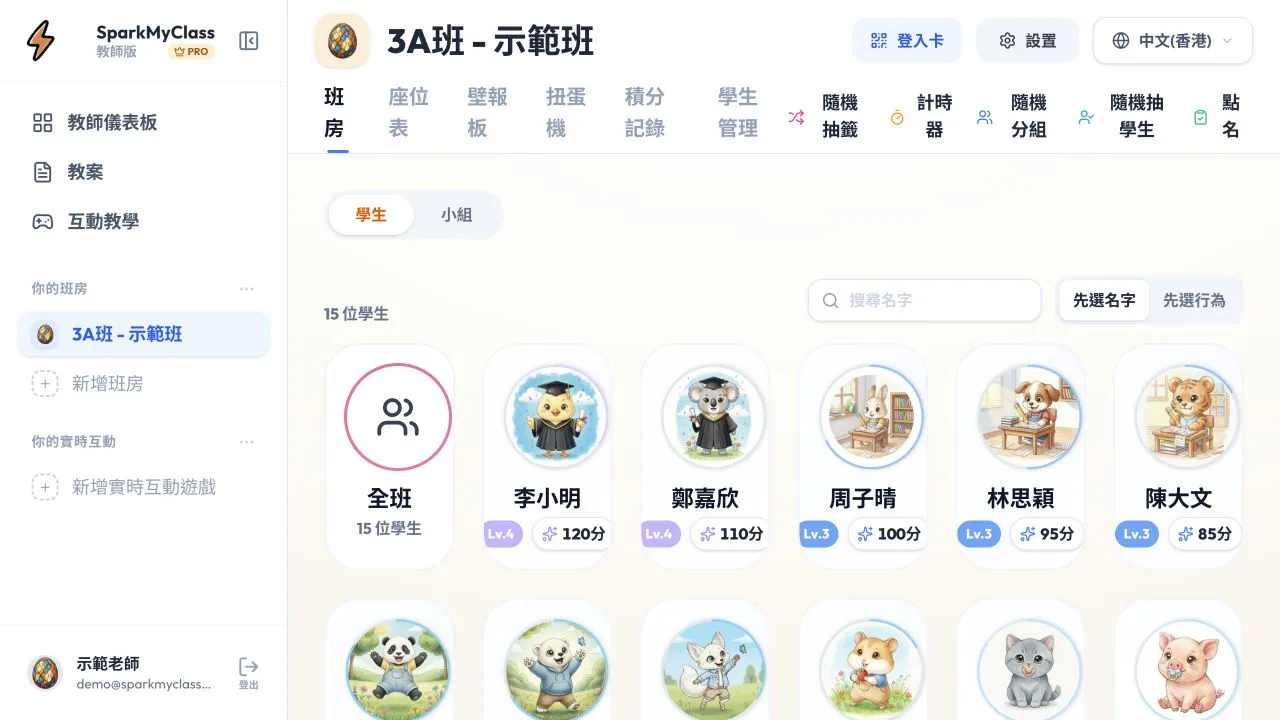
If you feel that designing and managing a full gamification system on your own would take more time and energy than you can spare, there are tools built specifically for this purpose. SparkMyClass, for example, is a gamified classroom management platform designed for teachers. It comes with a built-in behavior point system, a pet evolution mechanic, and interactive quiz games that put many of the gamification principles we discussed today into ready-to-use features. You do not need to build a system from scratch to bring gamification into your classroom.
However you choose to begin, the most important thing is to take that first step. Your students are waiting for a lesson that makes their eyes light up. And now, you have the knowledge to make that happen.
What to Look for in a Classroom Gamification Platform
Compare tools on whole-class live interaction, a no-device fallback, long-term progress beyond a one-off leaderboard, integration with everyday class routines, privacy and export controls, and the time needed to set up the first activity.
Related Practical Guides
Sources
Bring Gamification Into Your Classroom
SparkMyClass features behavior points, pet evolution, and interactive quiz games — making gamified classroom management effortless.